Guides · By Side by Side Refrigeration ·
Sub-Zero Refrigerator Leaking Water: Trace It to the Source
A Sub-Zero refrigerator leaking water usually traces to one of four sources: a blocked defrost drain, the drain pan, the water supply line or valve, or a door seal letting in warm air. Here is how to tell them apart and what you can safely check.
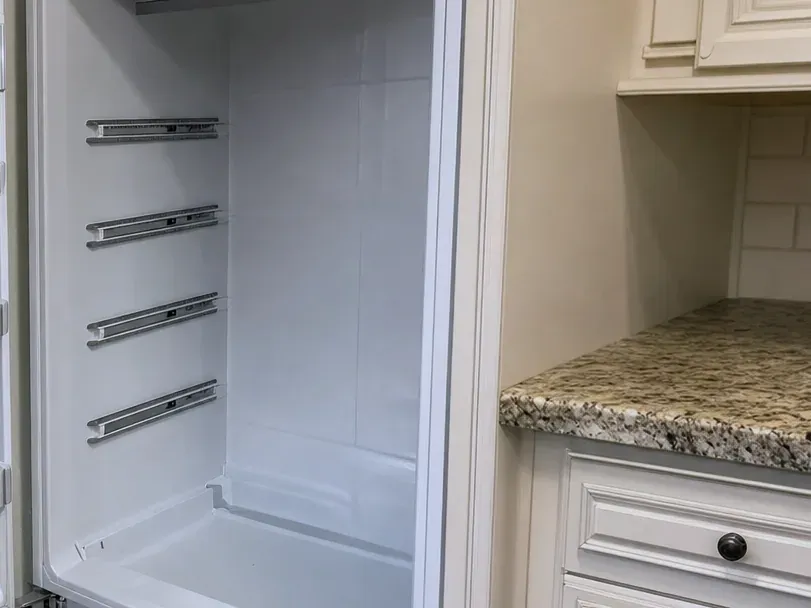
When a Sub-Zero refrigerator leaks water, the spot where the water appears tells you most of the story. Water pooling under the crisper drawers, or freezing into a sheet on the freezer floor, points to a blocked defrost drain. A puddle on the floor at the base with a dry interior usually means the drain pan, the supply line or the valve that feeds the ice maker. Wet gaskets and drips running off the door edge point to a seal that is letting room air in. Left alone, a slow leak under a built-in can soak the subfloor and the cabinetry the unit is set into, and that is true whether your kitchen is in the original 1950 village or in the Denver Tech Center part of Greenwood Village.
Look first: where does the water show up?
Towel everything dry and give it an hour or two. Lay a strip of paper towel along the floor at the base and another across the bottom shelf. Whichever one gets wet first narrows the list:
- Inside the fresh-food side, under the drawers: the defrost drain.
- Ice on the freezer floor or around the ice bin: the defrost drain or the ice maker’s fill.
- On the floor at the front, interior dry: the drain pan, supply line or water valve.
- Along the door edge or on the gasket: a door that is not sealing.
If you are unsure which side of the cabinet the water comes from, remember that each side of a Sub-Zero has its own sealed system and its own evaporator coil, as explained in two cooling systems in one cabinet.
Water under the crisper drawers: the defrost drain
At intervals the cold coil warms up just long enough to shed its frost. That melted frost trickles along a channel beneath the coil, then through a narrow tube that empties into a shallow tray, and the tray sits close enough to warm components that the water slowly dries off. If the tube’s opening clogs with food debris or freezes shut, that water has nowhere to go. It collects under the crisper drawers, refreezes into a glassy layer on the freezer floor and eventually escapes past the door bottom, which is why so many owners describe the problem as a leak from the door.
A frozen drain often follows a door left open overnight or a defrost part that has quit, since both load the coil with extra frost. Dark compartment lamps offer a hint on the Classic (CL) and Designer (DET, DEC): those models kill the lights on purpose whenever a door or drawer stays cracked, so the bulbs add no warmth. Push every door and drawer closed, give it a full hour, and only book a visit if the lights stay dark.
Both the Classic and Designer manuals handle thick ice the same way: power the refrigerator down, then aim a hair dryer at its lowest heat at the buildup and keep sweeping it back and forth. PRO Series owners get different advice in their manual: reach for a handheld steamer instead, and leave the hair dryer in the drawer. Either way, keep water away from the lights and controls and mop as the ice gives way. If the drain freezes up again within a week or two, the defrost heater, its thermostat or a sensor is the likelier culprit, and that is a repair rather than a cleanup.
A puddle at the base: drain pan, supply line and water valve
Water on the floor with dry shelves means the leak is outside the food compartments.
The drain pan catches the defrost water. It can crack, get knocked out of place when the unit is rolled out for cleaning, or overflow when the drain is delivering far more water than usual. Where it sits depends on the model, so read your use and care guide before you go hunting, and switch the power off at the breaker first.
The supply line carries household water to the ice maker and any dispenser. Leaks begin at the shutoff valve, at a compression fitting that has worked loose, or along a plastic line that has turned brittle or got kinked when the refrigerator was pushed back into its opening. Close the shutoff. If the puddle stops spreading, you have found the area.
The water valve opens to fill the ice maker. One that sticks partly open keeps dribbling, which shows up as a slow floor puddle, an overfull ice tray or cubes fused into a single block in the bin. That valve is a job for a technician, since live wiring sits right beside it.
Leaks that begin right after a filter change
If the water appeared the same week you swapped the filter, start there. Sub-Zero’s routine for a Classic (CL) starts with raising the grille from its lower edge. Give the spent cartridge a counterclockwise one-quarter turn so it comes free. The replacement must lose its plastic cap before it goes in; push it into place, turn it clockwise, and respond to the prompts on the control panel. A filter that has not been turned all the way, or one fitted with its cap still on, can weep at the head. Reseat it and dry the area so you can tell whether the moisture comes back. If you are unsure which series you own, see Classic or Designer.
Air caught behind a new cartridge also makes the line sputter and drip. Sub-Zero’s purge instructions differ by model: on non-dispenser Classic and Designer units you dump the first two full bins of ice the machine makes, on dispenser units you let water run for two minutes, and on the UC-15I you toss only the first batch. A few spitting glasses at the dispenser are normal; a drip that carries on afterward is not. As for the Snooze/Refresh prompt on Classic and Designer touch controls, it simply says the filter or the air purification cartridge is due, and it has nothing to do with water on the floor.
Wet gaskets and a sweating door
Moisture on the gasket or running off the door edge is condensation: warm room air is reaching cold surfaces through a gap. Greenwood Village sits in the semi-arid Front Range, and indoor air gets especially dry in winter with the furnace running, so a sweating Sub-Zero door here is rarely just the weather. It nearly always means the door is not closing all the way or the gasket has a gap.
Check three things. First, look for anything in the way: a crowded door bin, a tall bottle or a drawer not pushed fully home. Second, trap a slip of paper in the closed door at a handful of spots along the frame; wherever it pulls free without resistance, the seal is weak. Third, inspect the gasket for splits and flattened stretches.
For cleaning, Sub-Zero’s advice is to power the unit down first. Everyday grime comes off with a soft cloth dampened in water and a little mild detergent, tougher stains respond to a paste of baking soda, and mold or mildew calls for one part bleach in ten parts water. Vinegar and rubbing alcohol are both on the company’s do-not-use list. Splits, tears or cracks in the rubber mean replacement rather than cleaning. Sub-Zero would rather a technician handle that swap, and gaskets come only from the company’s parts distributors, never from online shops. Pay attention if the display is also flashing Vacuum Condenser while the gaskets are wet; poor door sealing is one of the conditions that brings up that message.
What you can check yourself, and when to call
The safe owner checks are the ones above: dry and observe, clear whatever blocks the door, clean the gasket, reseat the filter, close the water shutoff and melt heavy ice the way your guide describes. Stop if the next step means removing panels, unplugging wiring or reaching near the compressor. Call when the drain refreezes after you have cleared it, the floor puddle returns with the water off and the pan in place, the gasket is damaged, or the refrigerator is warm as well as wet. Sub-Zero’s own troubleshooting says that once a refrigerator dialed to 38 has climbed past 48 degrees, cleaning the condenser rarely brings it back, so that reading is your cue to stop. You can arrange a visit through refrigerator repair in Greenwood Village or by calling (720) 730-7551.
What a leak repair typically costs
The final price depends on what the diagnosis turns up, so treat these as typical figures, with a firm quote once the technician has looked at the unit:
- Door gasket or seal replacement: $280–$640
- Ice maker, water valve or supply line: $290–$770
- Defrost heater, thermostat or sensor: $290–$640
- Evaporator or condenser fan motor: $330–$680
For $89 a technician comes out and diagnoses the fault, and the fee is credited toward the bill if you choose to repair the refrigerator rather than replace it.
Questions
Why is my Sub-Zero fridge leaking water inside?
Water inside a Sub-Zero fridge, usually under the crisper drawers, almost always means the defrost drain is blocked or frozen. Meltwater from the coil has nowhere to go, so it pools and refreezes. Melt any ice the way your use and care guide describes, then watch whether it returns; a drain that refreezes points to a defrost part that needs a technician.
Why is my Sub-Zero refrigerator leaking water from the bottom?
A leak from the bottom with a dry interior usually comes from the drain pan, the water supply line or the valve that fills the ice maker. Close the water shutoff; if the puddle stops growing, the supply side is to blame. If water keeps appearing, the drain pan may be cracked, out of position or overflowing.
Why is water dripping from my Sub-Zero door?
Drips at the door are usually condensation from a seal that is not closing fully, or defrost water from a blocked drain spilling out past the door bottom. Look for items holding the door open and check the gasket for tears. A torn gasket should be replaced, and Sub-Zero recommends having a technician fit it.
Can a leak mean my Sub-Zero is not cooling properly?
Yes, a leak and weak cooling often share one cause: frost piling up on the coil because defrost has failed or a door was left ajar. The ice chokes the airflow so the fridge warms, then it melts into more water than the drain can carry. A thermometer showing over 48 degrees in a fridge set for 38 is past the point where condenser cleaning tends to help, according to Sub-Zero, so book a technician.
Can I still use my Sub-Zero while it leaks?
For a short while, yes, as long as it still holds temperature and you keep the floor dry. Close the water shutoff if the leak is on the floor side and keep towels at the base to protect the cabinetry and flooring. Book service soon, because water sitting under a built-in can quietly ruin the subfloor.
Your Sub-Zero, back in working order
Call Side by Side Refrigeration at (720) 730-7551, or choose a time online. Tell us whether it is a Classic or a Designer unit.